
Dr. Sandeep Mittal, IPS + Follow Published Jul 14, 2026
The current landscape is a wake-up call. Cybersecurity is no longer a technical problem for IT departments; it is a core part of our economic survival. We are being pushed into a digital economy that is increasingly hostile, using tools like simple passwords that are like using a screen door to stop a hurricane. For the common man, the era of “set it and forget it” security is over. Finance runs on confidence. If we lose faith that our digital balances are real, the whole system faces “systemic friction.” As the walls of the traditional bank vault crumble, we must demand that institutions and law enforcement move beyond “box-ticking” and physical-theft mindsets toward true, high-velocity resilience. Until then, the digital pickpocket remains just one click- or one deepfake- away.
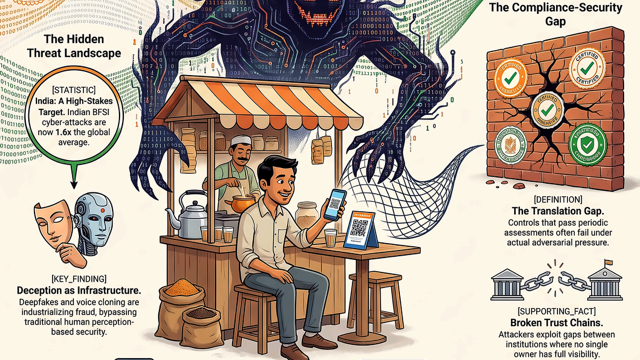
For decades, the “common man” viewed the bank vault as the ultimate symbol of security, a heavy, steel-clad promise that their life savings were untouchable. But as we move deeper into 2026, that vault has been replaced by a “distributed mesh” of cloud servers, APIs, and AI models. The latest Digital Threat Report 2025-26 reveals a chilling reality, the walls are not just thinning; they are dissolving into a complex web that neither you nor your bank fully controls. For the average citizen, digital banking was sold as a convenience. We were told that biometrics, instant payments, and mobile apps would make life easier. They did. But they also created a “threat surface” so vast that traditional protection is becoming obsolete. What does this mean for the person just trying to pay their rent? It means we are living in an era where the pickpocket is invisible, the thief moves at “machine speed,” and the law enforcement machinery meant to protect us is still stuck in the 20th century.
The Audit Illusion and the Liability Loophole
A disturbing trend is the “Compliance-Security Translation Gap.” Many banks pass their periodic “box-ticking” assessments only to fail miserably when faced with actual adversarial pressure. An institution might be “compliant” on paper while its actual protection envelope is narrower than the real attack surface. For the common man, this raises a terrifying question of liability. When a “Logic Abuse” attack occurs, where hackers don’t “break” the code but manipulate the bank’s own workflow to drain accounts, who is responsible? Current frameworks are often murky. While the Reserve Bank of India and Government policies suggest limited liability for customers who report fraud early, the burden of proof often shifts to the victim. Banks frequently argue that an OTP was shared, even when sophisticated “session hijacking” or “token interception” means the user did nothing wrong. We must demand that when a bank’s systemic logic fails, the liability must rest squarely on the institution, not the individual.
The “Thanedar” Mindset: Why the Police are Failing Us
While the Ministry of Home Affairs (MHA) has made significant strides by establishing the Indian Cyber Crime Coordination Centre (I4C) and the National Cybercrime Reporting Portal, a massive hurdle remains, the mindset of the local investigator. In most police stations, the “Thanedar” mindset still prevails. A petty physical theft of a few thousand rupees or a stolen mobile phone often receives more attention and paperwork than a cyber fraud amounting to crores. There is a psychological comfort in physical evidence, a broken lock or a recovered bicycle. Digital evidence, which exists in “memory-level artifacts” or “encrypted egress,” feels like a ghost to the traditional supervisor. This cultural lag is a boon for criminals. While a supervisor might spend hours tracking a local pickpocket, the digital thief operating from a different continent at “machine speed” is often dismissed as a “technical matter” for a specialized cell that is perpetually overworked.
The “Golden Hour” and Recommendations for Investigators
Government policy notes from the MHA emphasize the concept of the “Golden Hour.” In financial cyber fraud, the first two hours after the crime are the only window where money recovery is realistically possible. Once the money moves through three or four layers of “mule accounts,” the trail goes cold as it is often converted into cryptocurrency or moved across borders. For cybercrime investigators, the recommendations are clear but require a radical shift in operation,
1. Immediate Interdiction: Investigators must move away from “manual-only containment.” Using the MHA’s Citizen Financial Cyber Fraud Reporting and Management System (CFCFRMS), accounts must be frozen at the bank level within minutes, not days.
2. Beyond the OTP: Police must stop assuming that every fraud is a case of “user negligence.” If an attack uses “Synthetic Reality” or “Deepfakes,” the victim’s senses were literally deceived by industrialized infrastructure.
3. Algorithmic Investigation: Supervisors need to prioritize “Mean Time to Contain” as their primary metric. A case that is not acted upon in the first four hours should be viewed as a failure of the investigative process itself.
Industrialized Deception: When You Can’t Trust Your Own Senses
We have entered the age of “Synthetic Reality.” If you receive a video call from your boss or a voice note from a relative in distress asking for money, you can no longer trust your eyes or ears. AI-driven deepfakes have been “industrialized.” Scammers are using AI to create “context-aware” phishing that is indistinguishable from legitimate bank communications. If the bank’s own identity verification mechanisms can be fooled by AI-generated documents, the average person stands little chance. We are being asked to be the gatekeepers of our own accounts in a world where the keys can be forged in seconds by a bot.
The Price of Convenience
The current landscape is a wake-up call. Cybersecurity is no longer a technical problem for IT departments; it is a core part of our economic survival. We are being pushed into a digital economy that is increasingly hostile, using tools like simple passwords that are like using a screen door to stop a hurricane. For the common man, the era of “set it and forget it” security is over. Finance runs on confidence. If we lose faith that our digital balances are real, the whole system faces “systemic friction.” As the walls of the traditional bank vault crumble, we must demand that institutions and law enforcement move beyond “box-ticking” and physical-theft mindsets toward true, high-velocity resilience. Until then, the digital pickpocket remains just one click- or one deepfake- away.
Source: CERT-In, CSIRT-Fin, & SISA. (2026). Digital threat report 2025-26: For the banking financial services and insurance (BFSI) sector. SISA; Government of India, Ministry of Electronics & Information Technology.


0 comments on “The Invisible Pickpocket: Why Your Digital Bank Balance is No Longer a Private Matter”