
 by Sandeep Mittal August 13, 2026 in General, Internal Security Reading Time: 3 mins read
A recent security breach involving elite naval surveillance drones has exposed a critical vulnerability in global defence procurement. This incident serves as a definitive warning: in a globalised market, “paper compliance” is no longer a substitute for technical sovereignty.
Introduction
A recent security breach involving elite naval surveillance drones has exposed a critical vulnerability in global defence procurement. A routine assessment revealed that advanced K3 Scout drones, utilised by elite commando units, were secretly transmitting “heartbeat” signals to an IP address in Beijing for months. Although the British contractor had provided assurances that the third-party cameras were secure and “NDAA-compliant,” a failure in component-level origin checks allowed high-risk hardware to be embedded in the platform. This incident serves as a definitive warning: in a globalised market, “paper compliance” is no longer a substitute for technical sovereignty.
The Boardroom Challenge: Strategic Risks for Directors
For the Risk Committees of Boards of Directors, supply chain security is no longer just an operational IT concern; it is a fundamental threat to corporate and national integrity. The primary issues include:
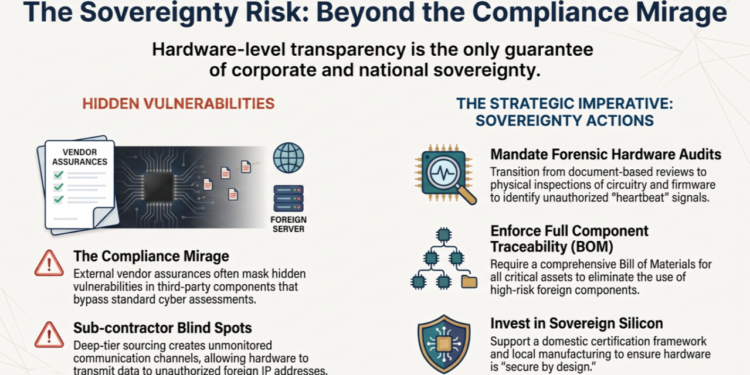
The Compliance Mirage: Boards often rely on international certifications as a guarantee of security. However, as this incident shows, sub-components can be sourced from high-risk jurisdictions and integrated into “certified” products undetected. Reliance on vendor assurances without independent verification is a systemic liability.
Sub-Contractor Blind Spots: Lead integrators often source specialised parts (sensors, communication modules) from a complex web of overseas manufacturers. This creates a “shadow supply chain” where the primary contractor may lose total visibility, and thus control, over the final product’s integrity.
Silent Persistence vs Outright Failure: Modern hardware breaches are rarely catastrophic “shutdown” events. Instead, they involve low-level, persistent communications (heartbeats) that can leak sensitive metadata, operational patterns, and even biometric data over long periods. Boards must understand that the “quietness” of these signals is what makes them a potent espionage tool.
A Way Forward
The Strategic Action Plan for India: As India pursues “Atmanirbhar Bharat” in the defence and technology sectors, the risk of “Trojan Horse” hardware remains high due to a continued reliance on imported active components. To preempt such incidents, Indian businesses and policymakers should adopt the following plan:
1. Mandate Forensic Hardware Audits: Standard software firewalls are insufficient against hardware-embedded backdoors. Critical equipment must undergo “Zero Trust” hardware testing in clean-room environments to monitor all outbound telemetry. No device should be deployed until its communication patterns are verified as legitimate.
2. Enforce Component Traceability (BOM): Contracts must move beyond vague non-disclosure agreements. Indian firms should demand a “Full Bill of Materials (BOM)” report that traces every chip, sensor, and capacitor back to its original foundry. Transparency in the “N-th tier” of the supply chain is non-negotiable.
3. Establish a Domestic Certification Framework: India requires its own robust certification standards for hardware used in critical infrastructure (Power, Telecom, Defence). This should include “Logic Testing” to verify that firmware on imported components has not been tampered with or programmed with unauthorised protocols.
4. Invest in Sovereign Silicon: The ultimate defence is indigenisation at the silicon level. For high-security applications, India must prioritise the design and fabrication of domestic semiconductors. If a nation cannot verify every transistor inside its equipment, it cannot truly claim sovereignty over its own security.
Sandeep Mittal
Dr. Sandeep Mittal is a Director General of Police and has interest in issues pertaining to governance in cyberspace. He has researched on human dimension of cyberspace, data privacy and claims to have developed preventive metrics for cyber crime ecosystem affecting Indian society and economy.


0 comments on “Securing India’s Digital Supply Chain: The Board Room Storm”